
Lessons from the Caerphilly By-election
by Simon Robinson, 24 Oct 2025
So we know the result now. Plaid Cymru took a very safe seat from Labour, with Reform some way behind. Here’s a graph of the results.
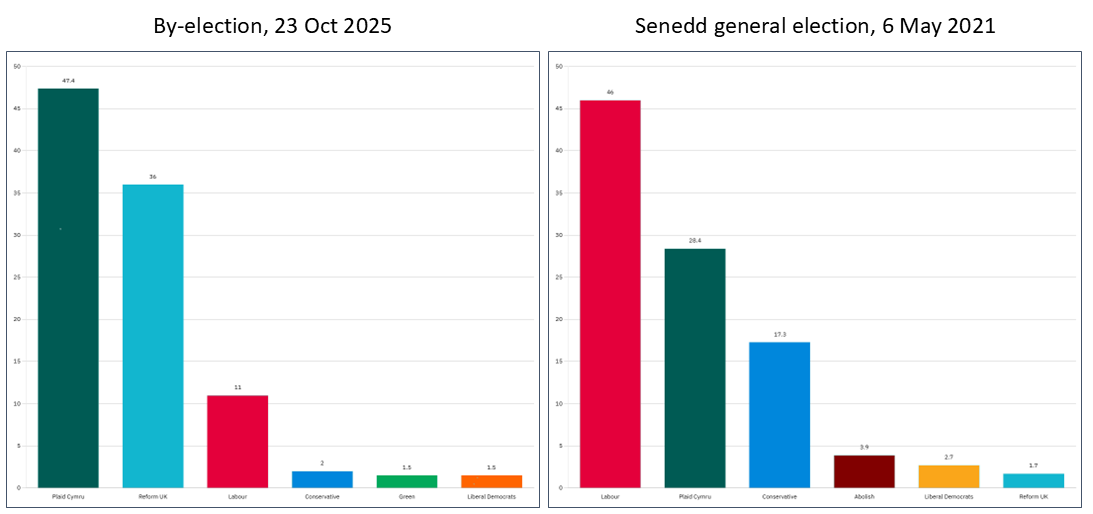
I have to say my reaction overwhelmingly is one of relief that Reform didn’t get the seat, despite being ahead of everyone else in the national polls. And this does give me some hope for the next general election.
You see what the result looks like to me is that anti-Reform voters came together behind the progressive party that looked most likely to beat Reform. That’s a bit of a guess, but there are several reasons why that looks very plausible:
Firstly, we know that Reform are divisive – as any party that is so far away from the political centre is going to be: For everyone willing to vote Reform or who thinks Farage is our saviour, there’s another voter who regards Reform/Farage as toxic. It’s hardly a surprise if those voters start voting tactically to stop Reform: After all, many of them are going to be the same voters who over several elections have already been voting tactically against the Tories.
Secondly, Plaid’s raison d’etre is Welsh Independence, but that is not something that Welsh voters on the whole want: Opinion polls consistently show that across Wales, about 50% are opposed to independence, and only 30% support it (see for example, ). Since support for independence tends to be concentrated in rural NW Wales, we can surmise that even fewer voters in Caerphilly would want it. But Plaid got 40% of the votes. So people are not voting for Plaid because they support Plaid’s aims! They voted Plaid for some other reason – and the obvious stand-out reason is that Plaid were the only progressive-ish party that wasn’t Labour and stood a chance of winning.
Thirdly, a large number of council elections over the last year have shown that a pattern that, very often, when either the LibDems or the Greens are putting up a strong fight, they tend to beat Reform. But when the contest is mostly between Reform/Labour/Tories, Reform win. Runcorn fitted that pattern: The fight was between Labour and Reform with no other contender and – surprise – Reform won (just) against a deeply unpopular Labour party.
All that is very consistent with the idea that, if you want to beat Reform, you need a strong anti-Reform 3rd party candidate.
I realise there’s a lot of guesswork there, but if – very plausibly - I’m right, that means we need to start working today to identify constituencies where we currently have little presence, but might be able to build an alternative to Reform/Labour/Tories. From the point of view of preventing a Reform Government, there might not be so much point campaigning in constituencies where Plaid/SNP/Greens are strong – because doing so risks splitting the anti-Reform 3rd party vote. I know we would like to take those seats and get more LibDem MPs – I’d like that too. And yes, I do worry in Scotland in particular about what a resurgent SNP would try to do to the UK. But I also think the prospect of a Reform Government is so awful that doing whatever we can to prevent it has to take priority. Caerphilly, as well as a large number of council by-elections, may have given us a clue how to do that.
Q: Why can't I comment on this article?
A: I do intend to allow commenting, but this is still a very new website, and I'm still working on coding up support for comments. Be patient 😉...