
Removing ILR, as Farage and the Tories Want, Would Destroy Lives
by Simon Robinson, 26 Oct 2025
Can you imagine, say, the person who runs your local corner shop suddenly disappearing because the Government has deported them? Or how about some of your colleagues from work, or the fellow parents you meet when you take your kids to school? Or a friend who has quite legitimately lived in the UK for many years, suddenly being told that the Government has changed its mind and she/he must now move to another country? Surely no UK Government, and no UK politician would dream of suggesting we do something so awful to anyone? Yet astonishingly, that is exactly what Nigel Farage appears to have promised will happen if Reform win an election. And the Tories have now followed suit: For that would be the inevitable consequence of the plans both parties have to remove Indefinite Leave to Remain (ILR) from people.
I think the reason this hasn’t generated as much horror as it should is that most people aren’t familiar with the immigration system. So when Nigel Farage talks of removing ILR, most people don’t know what that means. So let me explain:
First up, let’s be clear: We’re not talking about asylum seekers here, or people who arrive on small boats. We’re talking about people who have legally come to live in the UK by applying for a visa. There are lots of different visas available, but the main routes – which between them account for the vast majority of immigration – are people who have come here to work or study, or people who have come here because they are married to a UK resident.
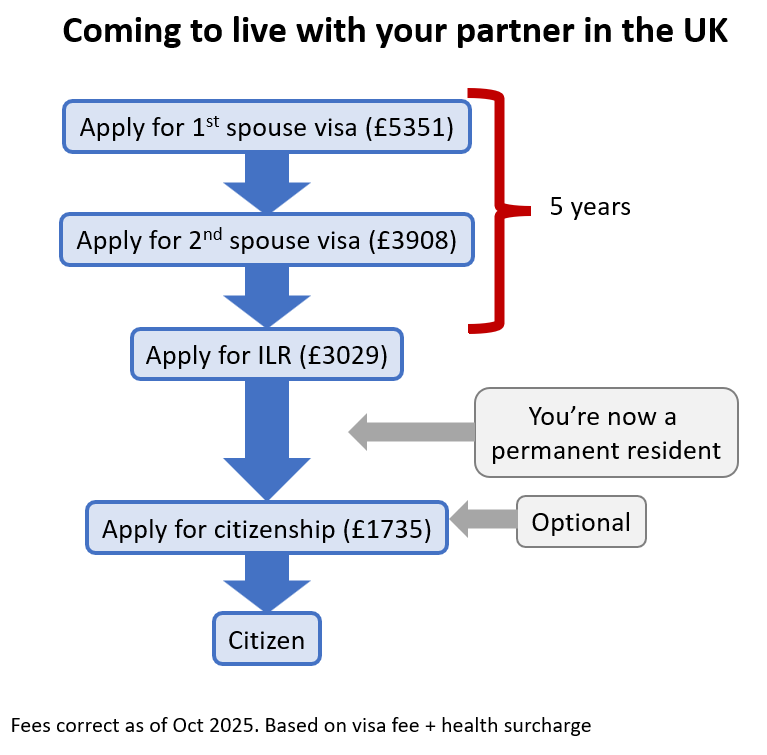
Let’s take marriage first. Suppose you, a UK citizen, fall in love with and get married to someone from another country. Naturally you want to live together, and for that your partner can apply for a spouse visa. This visa allows your partner to live with you in the UK for two years and nine months. At the end of that time, they must apply for a further visa that lets them stay here for another two and a half years. Once they have been living in the UK for five years, they can apply for ILR (Indefinite Leave to Remain) – which means they can stay here permanently.
The process is not cheap: At the time of writing, applying for the first visa costs £1,938 plus a compulsory healthcare surcharge of £3,413 (that’s a payment to be allowed to use the NHS while you’re here). The second visa costs £1,321 plus another healthcare surcharge of £2,587.50. Then applying for ILR costs £3,029. That means that, at the point you have ILR, you’ll have paid the Government nearly more than £12,000 in fees, in order to be allowed to live with your husband/wife. There are also eligibility requirements for the visas: You can’t apply for either visa unless you’re earning £29K a year (between you and your partner), and you’re not allowed to claim benefits during that time. Effectively, for the 5 years until you get ILR, it’s like you’re in the UK as a guest, allowed to temporarily live and work here provided you meet certain conditions. Then when you get ILR, that’s when you become a ‘proper’ resident here. Once you are on ILR, the ban on claiming benefits is dropped, so for example, if you lose your job, you’d be able to claim benefits like Universal Credit. But note that’s only possible because you’ve already been here and almost certainly been paying into the system for so long (visa fees plus tax). ILR also puts you on the road to citizenship: Once you’ve had ILR for a year, you can apply to become a British Citizen (on paying another £1,735).
The diagram shows the process.
If you’ve come here to work, the process is similar: You apply for successive visas over the course of 5 years, and then you can apply for ILR. However, this route is only available if you can find an employer who will sponsor you. And employers are only allowed to sponsor you if the work meets certain conditions, generally aimed at trying to ensure that people only come here to work if they are doing jobs that are required and for which no UK worker can be found. Those conditions mean that in practice, getting a job that will qualify you for a work visa is very difficult – and only likely to be possible if there’s a UK employer who really wants you. Foreign students who have studied at UK universities and who wish to remain permanently in the UK will typically use this route. Now to be clear, I’ve heavily simplified that explanation — there are all sorts of caveats and variations around the visa routes, but that gives the substance of the system. So what does that mean for someone who has ILR? Well most obviously, a person with ILR has lived here for a long time. Long enough that they are likely to have an established life here, and may well be living with a partner or have children here too. They have also paid a lot of fees to the Government on the understanding that those fees will allow them to become permanent residents. If the Government subsequently removes their ILR, then the Government is breaking the agreements it has already made with those people – and in the process, very likely wrecking their lives and the lives of their (British) families. Hopefully I’ve said enough to make it clear that arbitrarily removing ILR from people would be despicable and totally wrong.
Now with that background – what have Reform and the Tories actually said?
Nigel Farage has said he will abolish ILR and therefore require foreigners living in the UK to keep reapplying for visas. He has been a bit vague about the details — but look what he said in this interview:
There are those here on Indefinite Leave to Remain who are living on benefits. Would we be free from legal challenges, well of course having cut out, having cut out the human rights act…. We are not for a minute pretending that going back through the backlog is an easy thing to do, it’ll be complex, it’ll come in many forms, but we do intend to address it.
There’s not really any other way to interpret that other than that he intends to remove ILR from people who already have ILR and happen to have started claiming benefits. Think again of the implications here: Someone with ILR has – remember – paid a huge sum of money to the Government. They or their UK partner has almost certainly been working, earning money and paying tax for years before they need to start claiming benefits, so there’s no moral reason why they shouldn’t be able to get benefits if they need to. Also, you basically cannot apply for a visa to stay in the UK If you are receiving benefits, so if ILR is removed from someone in that situation, that would almost certainly mean they get deported (and potentially separated from their British wife/husband).
In other words, either Nigel Farage hasn’t thought through his policy at all, or he intends to deliberately destroy the lives of permanent UK residents who have lived here for many years. (Reform supporters: Do you really think someone who wants to do that is worthy of your vote?)
Now for the Tories: If anything, what they have said is even worse. Here’s what Katie Lam, Tory MP for Weald of Kent and opposition assistant whip, said on 8 September in a debate about ILR (https://www.parallelparliament.co.uk/mp/katie-lam/debate/2025-09-08/commons/westminster-hall/indefinite-leave-to-remain):
No new visa should be issued to, no new ILR status should be granted to, and existing ILR status should be revoked from, those who have committed a crime, accessed state support, or are unlikely to contribute more than they cost. Those who have no legal way to stay here would then need to leave.
That clearly shows the intention that a permanent UK resident with would be deported if they claim benefits. Once again, no matter that they were already given the right to claim benefits. No matter that might be married to a British Citizen and deporting could break up their family. No matter that they’ve spent years paying taxes plus visa fees to the UK Government.
It gets even worse: As reported in the Guardian: (https://www.theguardian.com/politics/2025/oct/22/deporting-legally-settled-people-broadly-in-line-conservative-policy-kemi-badenoch)
In an interview with the Sunday Times, Lam, a Home Office shadow minister and Tory whip, said many people would need to lose their ILR status in order to ensure the UK is mostly “culturally coherent”, prompting criticism from other parties.
Asked about Lam’s comments, Badenoch’s spokesperson said some had been “pulled out of context”. He said: “She said there are a large number of people who came to this country legally but shouldn’t have been able to do so. The leader of the opposition agrees with that.”
Highlighting the party’s plan to strip ILR from people who receive benefits, who commit a crime or whose income falls below £38,700 for six months or longer, he said: “I think that’s broadly in line with what Katie said and that is the Conservative party policy.”
There seems there to be a clear commitment that someone with ILR who claims benefits would have their ILR revoked and get deported – but even worse, there appears to be a justification that it would make the UK more culturally coherent. What??? Since when has wrecking lives for the sake of some abstract ‘cultural coherence’ ever been a decent thing to do.
Now there is a legitimate debate about high levels of immigration. I suspect few people would doubt that immigration has been too high and needs to come down. And that is a debate that I think the LibDems have not yet fully stepped up to. But lowering immigration – reducing the numbers of people coming to the UK – is not at all the same thing as deporting people who have already legally lived in the UK for many years – and remember again, we’re talking about people who legally came here by applying for visas, NOT people who have arrived illegally.
What the Tories and Reform are proposing is just so wrong. And it makes me for one even more determined to do everything I can to make sure that neither party gets anywhere near power.
Q: Why can't I comment on this article?
A: I do intend to allow commenting, but this is still a very new website, and I'm still working on coding up support for comments. Be patient 😉...