
Can LibDems Learn from the Labour Party Structure?
by Simon Robinson, 08 Nov 2025

Before I was in the LibDems, I spent a very long time in the Labour Party – long enough to become very familiar with how Labour is organised at local level, and also enough to see across several different constituencies how they get new members involved.
Now I don’t want to defend Labour politically – I eventually joined the LibDems because my own beliefs had evolved and, in the end I felt that politically and philosophically, the LibDems were the best match for me and the party I could most support. But in terms of organisation and party structure – I can’t deny I’ve felt disappointed. The LibDems are certainly good at community politics and also at focusing resources. But when it comes to local party structure and getting members involved, Labour is streets ahead of the LibDems. And I suspect that’s partly why Labour has so many more members – not just more than the LibDems, but more than any other party.
How Local Labour Parties Work
Let me explain how it works in the Labour Party. As a new member, you join a branch. Where I live in London, each branch covers one borough council ward (about 10K population), so it’s VERY local, but in areas where Labour is weaker, a branch might cover several wards. The branch usually meets once a month. Every member is welcome to attend every meeting – and for many people, that’s the main way you start to meet other members. The meetings can be lively: Decisions are made on local campaigning and events. And if the ward has Labour councillors, they will try to attend to say what they’ve been doing. There will likely also be political discussions. Often this happens because individual members propose ‘resolutions’ on something they are concerned about (basically, expressions of concern about some issue or requests for action). All this immediately gives a sense of being part of a community of Labour members, and makes it very easy for new members to quickly become active in the party, if they so wish.
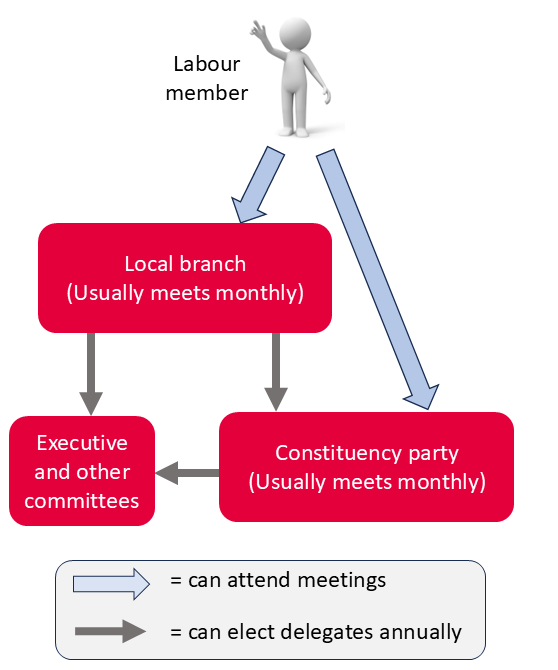
But that’s not all. Above the branch sits the constituency party – corresponding to a Parliamentary constituency. The constituency party also meets once a month. In times past, it was referred to as the ‘general committee’ and only open to delegates elected by each branch, but these days, in most places, constituencies have opted to have open meetings. That means any member living in the constituency can attend and fully participate – with the one exception that if there are any votes on anything, only the elected delegates can vote. Constituency meetings are similar to branch ones, but for a wider geographical area. And if it’s a Labour-held constituency (and the MP is sufficiently conscientious), that’s where they’ll be most months to report back to and get feedback from members.
That all means that, once you’ve joined Labour, you quite likely will have the chance to go to get involved and express your views almost every two weeks. And that’s how Labour looks to an ordinary member. The full structure is more complicated because there are other committees - for example, each constituency also has an executive committee, which deals with the boring admin side of running the local party. But the local branch and constituency are the point of contact for most members. There’s also a whole separate national structure (including the so-called National Executive Committee, which I would say is roughly equivalent to the LibDems’ Federal Council and Federal Board, rolled into one), but individual members tend not to interact with that. Personally, I was only involved with Labour at local level, so I had no experience of national Labour structure.
Labour doesn’t get everything right organisationally. The culture tends to be quite obsessive about rules and procedures, which wastes time and can be intimidating too. And particularly since Keir Starmer became leader, there has also been the widely reported problem of leadership attempts to prevent dissent and restrict free speech (I left the party before then), but that’s a problem of culture rather than party structures. There’s also always been an awkward relationship between the membership and the trade unions, who act as a separate voting part of the party - I don’t think Labour has ever really figured out how to democratically balance the rights of members with the influence of trade unions. That’s a problem the LibDems fortunately don’t have. But the key point is, if you join the Labour Party, you can get involved really quickly thanks to the open-to-all-members organisation of meetings.
Now obviously going to meetings doesn’t directly equate to campaigning and getting councillors elected. But it often leads to it – because if you know other members and you feel you’re being listened to and you have a say in decisions, then you’re much more likely to be motivated to do the hard work of canvassing etc.
Resolutions
Example of resolution: Excerpt from one I proposed at my local branch 10 years ago (when I was a Labour member)
… Providing a DLR line in Thamesmead, giving connections to CrossRail at Abbey Wood, would be a massive boost to Thamesmead, giving it rail access for the first time. … (text snipped)… We therefore call on Greenwich Council, in their response to TfL’s road crossings consultation, to ask that TfL to give equal priority to the proposed DLR extensions as to road building, and to recommend that if the proposed road building schemes go ahead, then a DLR link based on TfL's option 6 must form a part of this.
I should say more about Labour’s system of resolutions. As a Labour member, if there’s any political issue you feel concerned about and want to discuss/make your views known, the way to do it is to propose a resolution for your branch meeting. Members at the meeting will discuss the resolution, then vote whether to accept it. If appropriate, the resolution may then be passed to the local Labour MP or councillors, to inform them of member’s feelings.
Now to be clear, resolutions don’t generally change the World. Unless you’re asking the local party to do something specific, or your local councillors to do something specific, the resolution may well simply get discussed and then that’s the end of it. But I would say they are vital in allowing ordinary members to feel that they are heard and that their views matter – because of the way they allow anyone to start a discussion within the local party about any issue they are interested in or worried about.
Compared to the LibDems
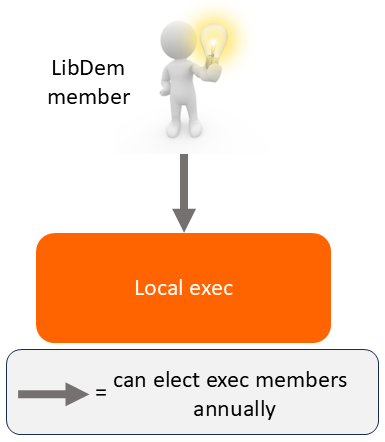
Contrast that with the LibDems. Now I should say before I start that I’ve personally only had LibDem experience in one local party, but from talking to other people, I get the sense that my experience is not untypical, so I think the following is a reasonable picture in many places: In the LibDems, the local party is likely to cover a bigger area (a whole borough – over 200K people where I live). It is run by an exec, elected by local members at an annual general meeting, and which then holds closed meeting through the year, at which essentially all decisions on running the party are made. I would guess that’s seen as efficient, but the problem is, that kind of structure also means there’s no regular channel for anyone not on the exec to have a say in the running of the party. Depending how active your local party is, there will hopefully be events organised: In my area that tends to take the form of, the occasional social or meeting to discuss some topic chosen by the exec. And of course, occasional campaigning. But the key point is, these are all decisions handed down by the exec. Compared to Labour, that inevitably makes it much harder for members – particularly, new members – to start to feel like they are part of an organisation that values them.
And I’m sure this has an electoral impact. One thing I’ve heard time and time again from other members I’ve spoken to is that when the LibDems lost most of their councillors during the electoral unpopularity of the coalition years, many local parties practically ceased to exist – because they depended so much on the activities of the councillors to keep the local parties going. To my mind, that’s a massive failing of party structure: Contrast that with Labour. Back in the 1980s I lived in rural Hampshire. At the time the whole area was very solidly Tory: Labour had no councillors at all and regularly got less than 10% of the vote. Yet despite that, they had a thriving local party, bringing campaigners together and making sure that Labour remained active and able to bring in new members. That was not atypical. And based on my experience, I’d say that was possible precisely because of Labour’s formal local structure and the regular all-member meetings.
Now to be clear, I do not intend this as any criticism of any local LibDem exec or of any individual LibDem members. People on any local exec are all volunteers, putting in their time, trying as best they can to help the LibDems – because they want to see a better country. And the ones I’ve met in my area are really, genuinely, nice people. But I feel they, and all members, are being let down by a party structure that just doesn’t lend itself to bringing in new members, and which just doesn’t evoke a sense of community in the way that Labour’s structure does. Considering it was the LibDems who pioneered community politics and also the LibDems tend to see themselves as focusing on local communities more than other parties, that is so ironic!Lessons for Us
I want to see the LibDems become a truly national party, but it seems to me we are being held back in that regard by lack of local-level party structures to engage members. I hope something there can change. That doesn’t necessarily mean we should adopt Labour’s system. For a start, we are restricted by having far fewer members than Labour – reportedly, something like 60 thousand members against Labour’s 300 thousand. 60K averages out at about 100 per Parliamentary constituency, which is probably not enough to sustain anything like Labour’s two-tier local structure. But I’m sure we can learn from the way Labour’s structures are designed from the start for a more local level and for all-members-welcome meetings. That’s something I’ll be thinking about quite closely over the next few months.
Q: Why can't I comment on this article?
A: I do intend to allow commenting, but this is still a very new website, and I'm still working on coding up support for comments. Be patient 😉...